Laboratory Chemicals
Laboratory Chemicals
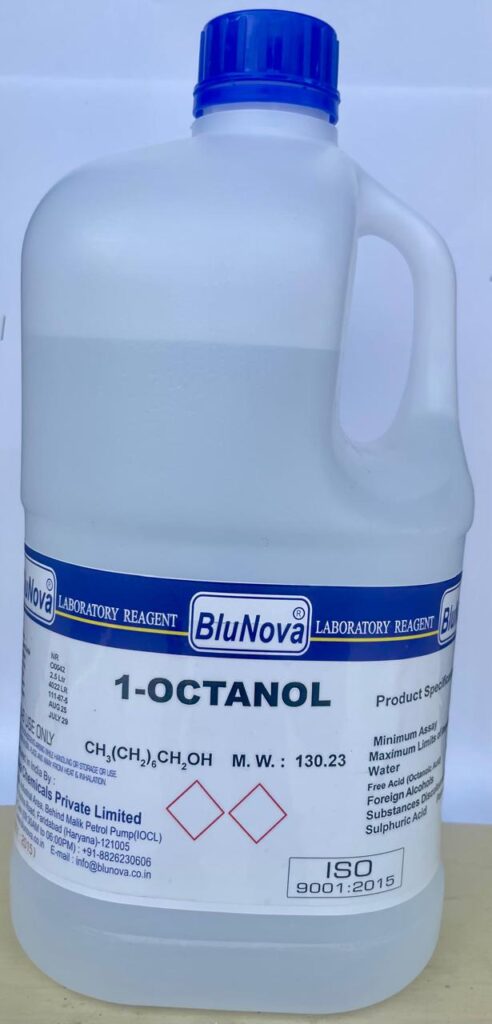
1-Octanol1-Octanol is a colorless to slightly yellow viscous liquid with a characteristic odor. It is a primary alcohol containing an eight-carbon straight chain. Commonly used as a solvent, reagent, and intermediate in organic synthesis, it plays a vital role in the production of esters and fragrances.
Applications:
-
Used as a solvent in laboratory and industrial processes
-
Intermediate for manufacturing plasticizers, surfactants, and esters
-
Commonly used in perfumes and flavoring agents
-
Research chemical in organic synthesis studies
We @ BluNova have complete in-house production facility with Stringent Quality Control measures in compliance to international standards.
Laboratory & Analytical Chemicals are packed for educational Institutes, Agriculture & Veterinary Institutes, Hospitals, Healthcare Laboratories, R&D & Q/C Laboratories, Defence & Pharmaceutical Laboratories etc
Chemicals
Solvents:
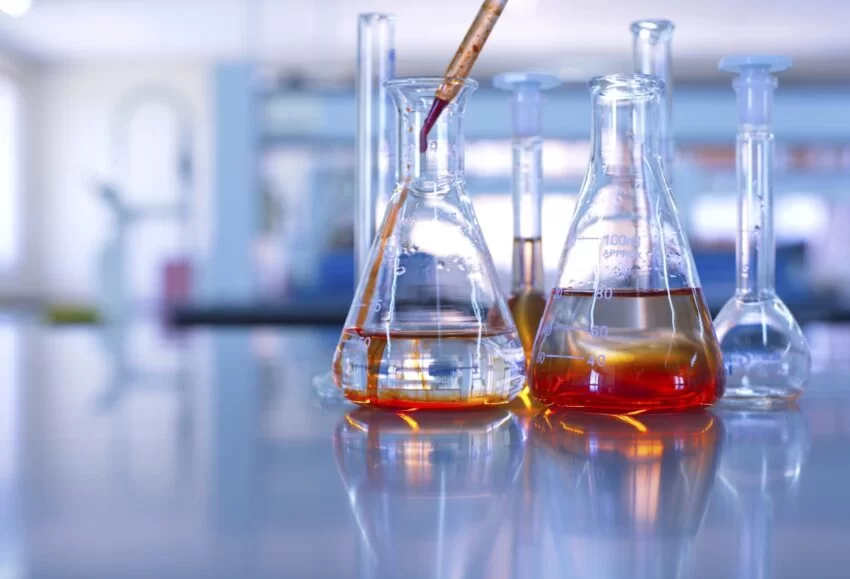
We offer complete range of LR/AR/HPLC/Electronic Grade/Dry Solvent. Our various capacity, state of art distillation reactors of both SS / GLR are well equipped & optimized for accuracy & perfection.
Our available Bulk Packs are of: 5Ltr, 25Ltr & 200Ltr (Plastic | GI & MS Drums/Cans)
Chemicals
Solids:
BluNova is recognized for a wide range of High Purity Products. Our production facility includes LR, AR, Molecular Biology Reagents & Reagents for Bio Chemistry & Microbiology. Our Production operation offers a wide range of products under one roof. Our team of Engineers & Chemists employ variety of ultra-modern techniques for the development of products as per requirement.
Our available Bulk Packs are of: 5Kg, 25Kg, 50Kg & 100Kg (Plastic | MS Drums/Jars with inner lined PP/HDPE Packing)
Chemicals
Molecules:
We expertise in production of molecules as intermediates for Research Work. Our products are of Superior Quality & Purity of each product is as per specification. We conduct series of tests at every stage of production.
Our available Bulk Packs are of: 1Kg, 5Kg, 25Kg, 50Kg (Plastic | MS Drums/Jars with inner lined PP/HDPE Packing)

Chemicals
You Can Find All Answers Here
Laboratory chemicals are substances used in scientific research, experiments, and testing. They serve various functions depending on the field of study, including chemistry, biology, physics, and materials science. These chemicals can be reagents, solvents, acids, bases, or specialized compounds used for specific analytical methods.
Find Out Answers Here
Laboratory chemicals come in different grades of purity, such as reagent grade, analytical grade, and technical grade. The purity required depends on the experiment or application, with higher purity often necessary for sensitive analytical methods.
- Acids and Bases: Commonly used for titrations, pH adjustments, and synthesis reactions (e.g., hydrochloric acid, sodium hydroxide).
- Solvents: Used to dissolve substances, clean equipment, or facilitate chemical reactions (e.g., ethanol, acetone, hexane).
- Salts: Utilized in buffer solutions, reactions, and as electrolytes (e.g., sodium chloride, potassium nitrate).
- Reagents: Chemicals used to cause a reaction, often in analytical tests (e.g., Benedict’s reagent, Fehling’s solution).
- Indicators: Compounds that change color to indicate the presence of certain substances or a change in pH (e.g., phenolphthalein, litmus).
- Laboratory chemicals can be hazardous and require careful handling. Proper storage, labeling, and use of personal protective equipment (PPE) are essential.
- Material Safety Data Sheets (MSDS) or Safety Data Sheets (SDS) provide detailed information on handling, hazards, and first aid measures for each chemical.
- Analytical Chemistry: Chemicals are used in tests like titrations, chromatography, and spectroscopy to determine the composition of substances.
- Synthesis: Laboratory chemicals are essential in creating new compounds, whether in research or industrial applications.
- Biotechnology: Chemicals like buffers, enzymes, and growth media are crucial in experiments involving biological systems.
- Proper storage conditions are necessary to maintain the stability and effectiveness of chemicals. This often includes temperature control, protection from light, and avoiding contamination.
- Disposal of laboratory chemicals must follow specific guidelines to prevent environmental harm. This can involve neutralization, special waste disposal services, or chemical recycling programs.